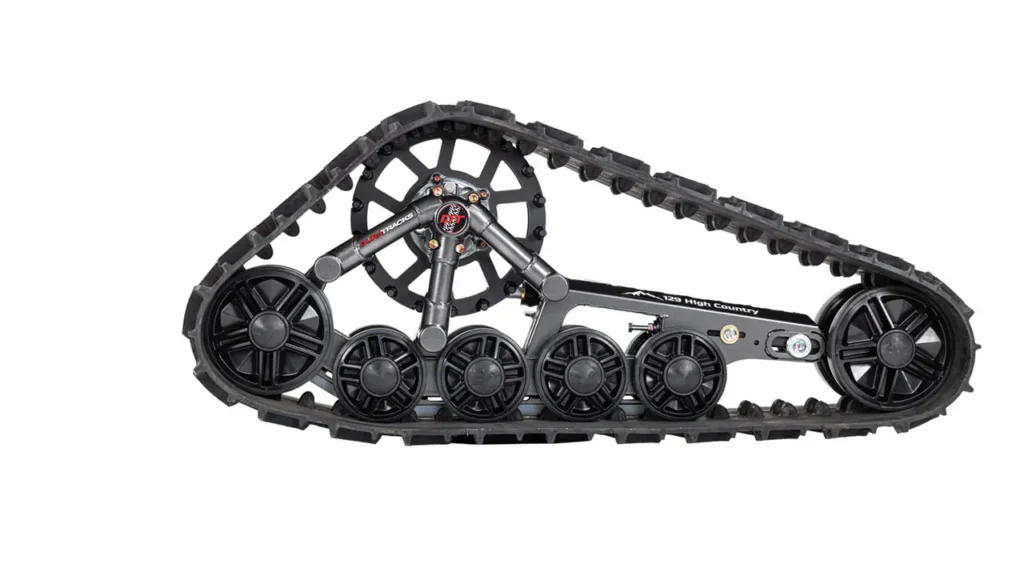
One of the biggest reasons people install tracks on a UTV is to reduce ground pressure. Whether you’re crossing deep snow, soft mud, wetlands, sand, or muskeg, lowering the amount of pressure applied to the ground helps your machine stay on top instead of sinking in.
But how much ground pressure does a UTV on tracks actually produce?
The answer depends on the weight of the vehicle, the amount of cargo you’re carrying, and perhaps most importantly, the size and design of the track system itself.
What Is Ground Pressure?
Ground pressure is simply the amount of weight distributed over a given area, usually measured in pounds per square inch (PSI).
Think about standing on snow wearing regular shoes. Your weight is concentrated into a relatively small area, so you sink. Put on a pair of snowshoes and that same weight is spread across a much larger surface, allowing you to stay on top of the snow.
A tracked UTV works exactly the same way.
The larger the contact patch between the tracks and the ground, the lower the ground pressure becomes.
Why Lower Ground Pressure Matters
Low ground pressure isn’t just about avoiding getting stuck.
It also improves flotation, reduces rutting, minimizes disturbance to sensitive terrain, and allows the vehicle to travel more efficiently across soft surfaces. That’s why tracked machines are commonly used by utility companies, search and rescue organizations, ski resorts, hunters, trappers, and land managers who routinely work in challenging conditions.
Instead of digging down into snow or mud, a properly designed track system spreads the vehicle’s weight across thousands of square inches.
Not All Track Systems Are Equal
Many people assume every track system performs about the same.
In reality, track length, width, wheel arrangement, suspension geometry, and the way the track conforms to uneven terrain all affect how much surface area actually contacts the ground.
Some systems concentrate more of the load on a smaller portion of the track, while others are designed to maximize the contact patch as the machine enters soft terrain. The more usable track surface that contacts the ground, the lower the effective ground pressure becomes.
Ground Pressure Changes with Conditions
Ground pressure isn’t a fixed number.
On hard-packed trails or pavement, only part of the track may carry the majority of the load. As the vehicle enters softer snow, mud, or sand, more of the track begins supporting the machine. This larger footprint spreads the weight over a greater area, reducing the pressure applied to the surface. That’s one of the key advantages of a properly engineered track system.
How Does This Compare to Other Machines?
People are often surprised to learn just how little ground pressure a tracked UTV can produce.
Many passenger vehicles exert well over 30 PSI through their tires. Even a person standing on one foot can produce several PSI of pressure depending on footwear. Larger construction equipment equipped with tracks often operates in the 4 to 6 PSI range because spreading weight over a large footprint dramatically reduces pressure compared to tires.
Modern UTV track systems can achieve remarkably low ground pressures by combining a lightweight vehicle with a very large contact area, making them ideal for deep snow and other soft terrain.
It’s About More Than a Number
While published ground pressure specifications are useful for comparison, they don’t tell the entire story.
Ride quality, steering effort, flotation, durability, approach angle, traction, and how the suspension reacts to changing terrain all play equally important roles. A track system that performs exceptionally well in deep snow may behave differently in mud or on rocky terrain, depending on how it’s engineered.
That’s why evaluating a track system should always involve more than comparing one specification on a chart.
The Duratracks Difference
Every DURATRACKS system is designed with one goal in mind: maximizing usable flotation while maintaining predictable handling and durability in real-world conditions. Features such as optimized wheel placement, engineered suspension geometry, and a large effective contact patch allow the tracks to distribute weight efficiently as terrain conditions change.
Whether you’re breaking trail after a heavy snowfall, crossing a remote swamp, or hauling equipment into difficult terrain, lower ground pressure helps your UTV travel farther with greater confidence while reducing its impact on the ground beneath it.